Thermal Weed Control with Hot Water and Steam
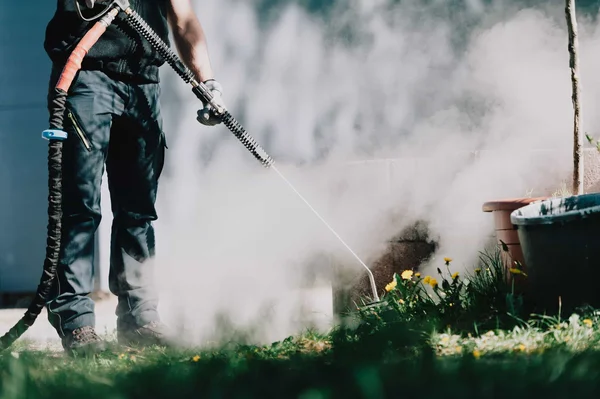
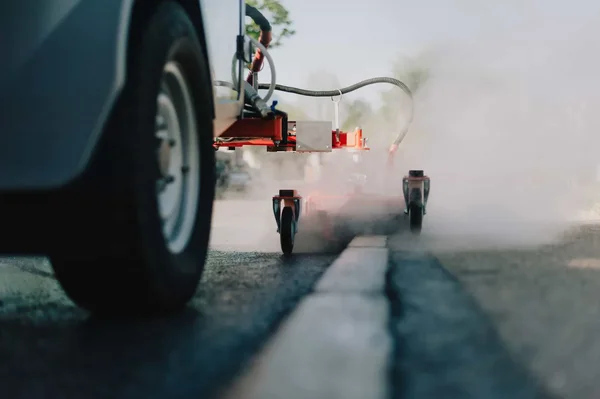
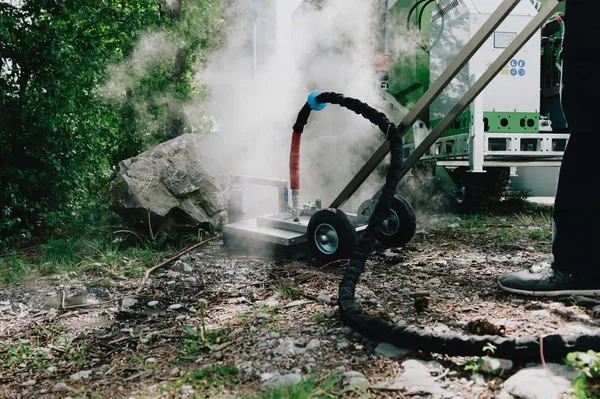
Thermal weed control with KECKEX offers an environmentally friendly and sustainable solution for weed removal on public, municipal, commercial, and private areas. Using a hot water-steam mixture of over 100 °C, the cell structures of the plants are destroyed. The heat not only acts on the surface but also penetrates deep into pavement joints, cracks, and the root area. This weakens the weeds long-term and controls them reliably.
In contrast to chemical weed control, the KECKEX method is completely free of herbicides. Weed eradication is carried out purely with water and heat – gentle on humans, animals, and the environment. This makes the method particularly suitable for use on sidewalks, parking lots, cemeteries, playgrounds, industrial areas, public spaces, and municipal facilities.
In addition to conventional weeds, invasive plant species can also be specifically treated. These include, for example, Japanese Knotweed (Japanknöterich), Himalayan Balsam, or Giant Hogweed. These plants are spreading increasingly and pose great challenges for many municipalities and property owners. Thermal treatment offers a sustainable way to curb their spread.
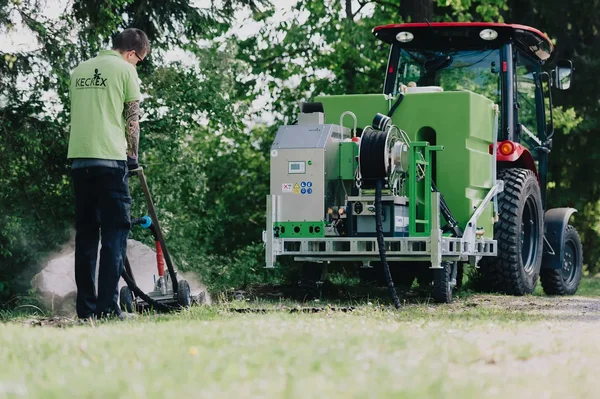
Another advantage of KECKEX systems is their versatility. The equipment can be used not only for thermal weed control but also for cleaning asphalt, paving stones, kerbstones, concrete surfaces, walls, and other surfaces. Thus, KECKEX combines weed removal and professional surface cleaning in a single system.
With KECKEX technology, municipalities, public works departments, service providers, and companies rely on a powerful, chemical-free, and future-oriented method of weed control – sustainable, efficient, and economical.
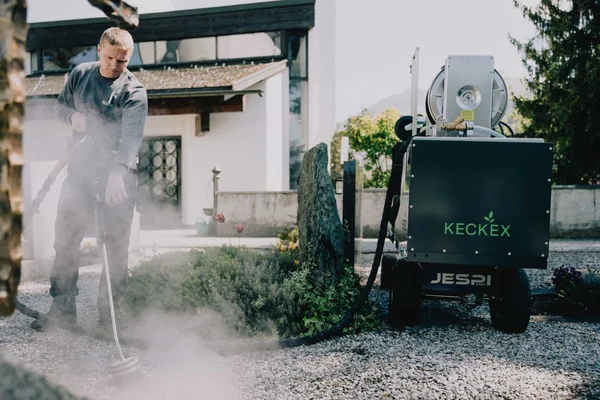
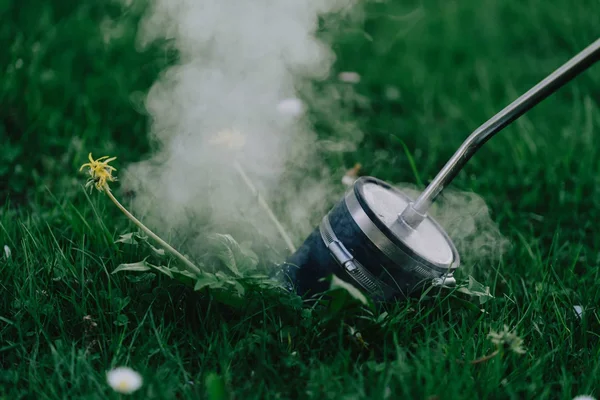
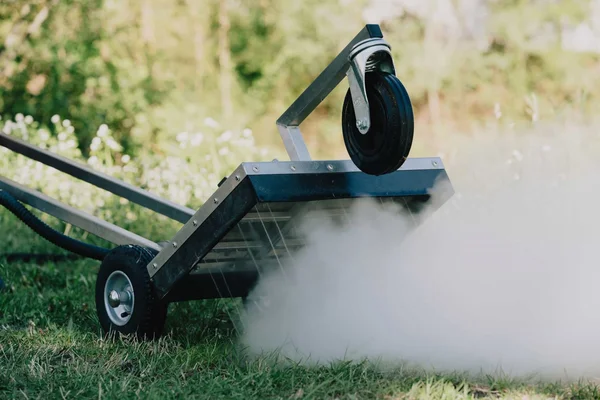
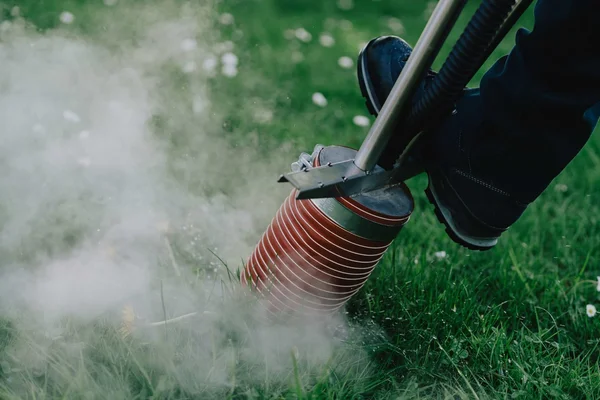
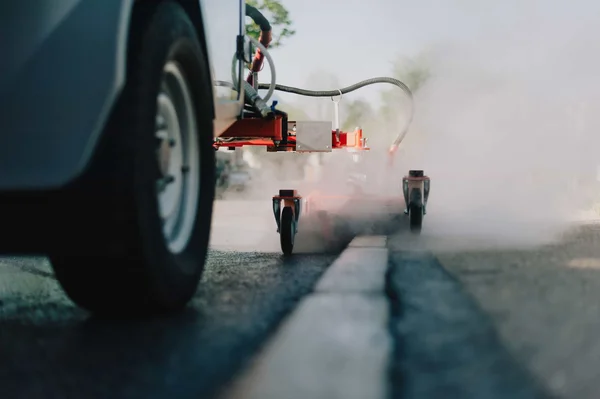
Discover the versatility of KECKEX products.
Load video — data will be transmitted to YouTube (Privacy policy)
Questions & Answers
For initial application, we recommend the KECKEX method. The desired area is treated with KECKEX devices, after 5-10 days the resulting dead plant material is removed, and then the desired spot is immediately treated again with KECKEX devices. Continuous treatment promises the best result.
The perfect conditions are a dry and warm surface for application, followed by a few dry and sunny days without rain. Changeable weather, such as sun during the day and rain in the evening, however, acts like a growth stimulant. Basically, the KECKEX method can be applied to any plant, but the species and genus of the plant are decisive for the duration of the application. The basic rule here is: The larger and stronger the weed, the more heat and water are required. Dandelions, for example, are particularly stubborn.
It is unfavorable to carry out an application during heavy rain, because the soil is cooled down and often unable to absorb the hot water. Thus, the hot water cannot penetrate to the roots, and the effect is not present.
Due to the protein shock in the plant, the color pigmentation is strongly irritated, resulting in a striking green. This is an indicator of a successful application.
This cannot be given a general answer, as plant type, soil condition, and vegetation can vary greatly. In addition, the water output of the different machine types must be considered. More water means a faster operating speed. However, from experience, we can say that it gets faster after each application.
The mixture of hot water and steam triggers a protein shock in the plant, rendering it unable to absorb water and subsequently causing it to dry out. The KECKEX method damages the plant's root collar, which the plant needs to sprout. If this root collar is continuously damaged, the plant can no longer sprout and will completely wither away.
The longer the plant, and especially its root system, is exposed to the hot water-steam mixture, the more severely it will be damaged, and consequently, the higher the success rate. Depending on the plant species and accessories, this can be in the range of seconds.
The goal of every treatment is to reach the root system and damage it with the mixture of hot water and steam. Depending on the plant species, this is achieved sustainably after just one application (moss), while for other weeds (e.g., dandelions), several treatments may be necessary.
Even the Chernobyl nuclear disaster did not manage to destroy weeds forever. When a plant seed meets nutrient-rich soil, the plant will grow – a process that neither we nor anyone else can stop. However, the KECKEX method can counteract this very effectively and, most importantly, chemical-free.
A hot water-steam mixture of up to 130 °C ensures that weeds on the treated surface are combated just as effectively as the root system. Since our accessories are completely sealed, the steam is enclosed, creating an atmosphere above 100 °C, which prevents the water from cooling down between leaving the nozzle and hitting the ground.
The steam acts superficially and prepares the atmosphere so that the hot water also hits the ground hot and uncooled. With pure hot water applications, more water must be used because it often hits the ground unprotected from a distance, immediately losing a few degrees and therefore also effectiveness.
a. Flaming: Besides the high risk of fire one exposes oneself to, flaming, like a forest fire, has a growth-promoting effect. For example, Aborigines in Australia have always used fire to make areas more fertile. b. Hot Air: Hot air is similarly dangerous to flaming, and its effectiveness is questionable. Furthermore, large quantities of propane gas are used. The effect is said to be better if the surface is wet – so one might as well work with steam immediately. c. Infrared: Handling is extremely simple and cost-effective. However, its effectiveness is also questionable, and it could cause difficulties for nearby individuals with pacemakers. d. Foam: The expensive foam offers no added value, looks unnatural, and often contains palm oil. It also attracts insects, and passers-by are startled by the sight. On non-horizontal surfaces, the foam flows away uncontrollably. e. Steam: Pure steam application superficially ensures rapid and environmentally friendly weed destruction. However, this is only superficial, and the weeds therefore grow back very quickly.
Since we only use water, there are no harmful residues on the plants. During an application, bees and other insects fly away beforehand and are therefore not harmed.